Agile vs Waterfall vs Hybrid: How to Choose the Right Project Approach
Compare Agile, Waterfall and Hybrid project management with practical examples. Learn their differences, advantages and how to choose the right approach.
Read insightLearn how to manage project scope changes with a practical change control process, impact assessment, approval workflow and change request example.
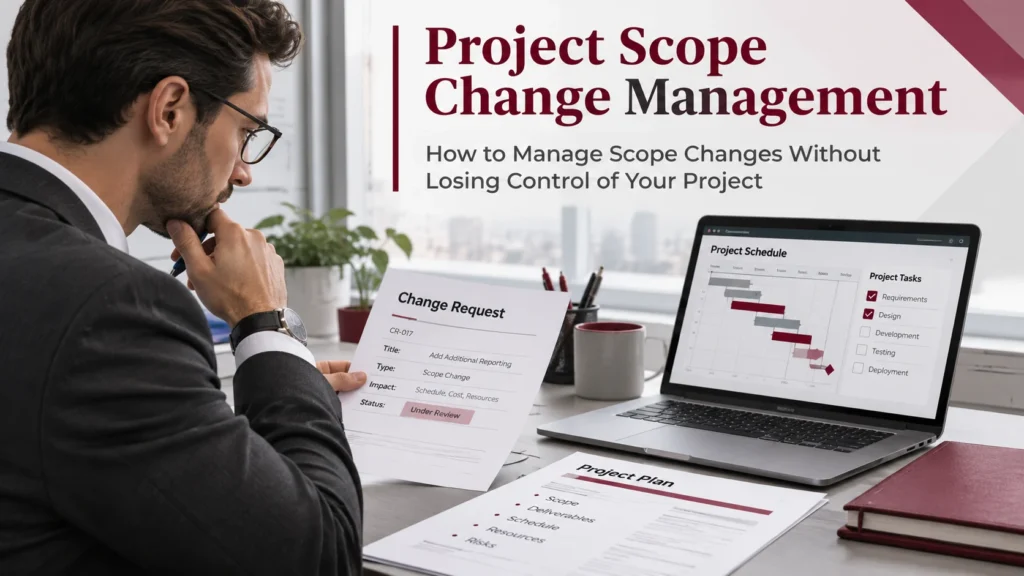
A client asks for one additional feature. A department wants to revise an approved requirement. A contractor suggests a design modification after procurement has already started.
Each request may appear reasonable on its own.
But small changes can affect work that has already been planned, approved or started. One additional feature may require more development, another round of testing and a later delivery date. A design change may affect equipment specifications, supplier commitments and the construction schedule.
This is one of the reasons project scope change management is so important.
Projects rarely proceed exactly as originally planned. Requirements evolve, technical problems emerge and business priorities shift. A project manager needs a reliable way to assess these changes before committing the team to additional work.
In this guide, we’ll explain how to manage project scope changes, prevent uncontrolled scope creep and establish a practical change control process. We’ll also look at examples from engineering and IT projects, along with a sample change request and change log you can adapt for your business.
A project scope change is a proposed modification to the work, deliverables, requirements or agreed boundaries of a project.
For example, imagine a business has approved a project to build a website with five main pages, a contact form and a customer enquiry system.
Halfway through development, the client asks for an online booking feature.
That request changes what the project is expected to deliver. It may involve additional design, development, integration and testing.
The new feature could be valuable, but its impact should be assessed before the team agrees to deliver it.
The Association for Project Management (APM) defines change control as the process of capturing, assessing and deciding on requests that affect an approved project baseline.
In practical terms, this means a change should be recorded, its consequences understood and the appropriate decision-maker involved.
A scope baseline is the approved reference against which changes to project scope are assessed.
In a predictive project, it commonly includes:
Together, these help establish what the project is expected to deliver.
The scope baseline is closely connected to the schedule and cost baselines. If the approved work changes, the project manager may also need to revise the planned dates, budget or resources.
Without an agreed baseline, it becomes difficult to distinguish between work that was already included and work being newly requested.
These terms are often used interchangeably, but there is an important difference.
A scope change is a modification to the project’s agreed work. It can be properly assessed, approved and incorporated into the project.
Scope creep occurs when project scope expands without adequate control over the corresponding work, costs, resources or schedule.
Consider two situations.
Scenario A: Controlled scope change
A client requests an additional reporting dashboard. The team estimates the work, identifies the schedule impact and presents the options. The client approves a revised budget and delivery date.
The project now has more work, but the change has been formally agreed.
Scenario B: Scope creep
A client requests the same dashboard. A developer starts building it immediately to keep the client happy. No estimate is prepared, no approval is recorded and the original delivery date remains unchanged.
The team is now expected to complete more work within the existing commitments.
The second scenario creates the conditions for scope creep.
This distinction matters because the objective of change control is to support informed decisions. A worthwhile change should still be considered, provided its consequences are understood.
For related causes of project overruns, read our guide on Why Projects Fail: 10 Common Causes and How to Prevent Them.
Scope changes arise for many reasons. Some are avoidable, while others are legitimate responses to new information.
A project begins before stakeholders have fully explained what they need.
As work progresses, missing requirements become visible.
For example, a business may discover that its new CRM system needs a customer approval workflow that wasn’t included in the original requirements.
Management may introduce new objectives in response to customer demand, competition or operational needs.
A feature considered optional during planning might become essential before launch.
Engineering and IT projects can uncover technical constraints that were not apparent during initial planning.
An installation team might find that an existing pipe route conflicts with the approved design. A software team may discover that a third-party integration works differently from what was expected.
Different departments often have different expectations.
Marketing may want additional website functionality. Finance may request new reporting fields. Operations may need an extra approval step.
Without a clear process, these requests can accumulate.
Changes to applicable rules, permits, contractual requirements or compliance obligations may require a project to adjust its design or delivery plan.
Such changes may be unavoidable, but they still need to be documented and assessed.
The project manager’s responsibility is to understand why a change is needed and manage its effect on delivery.
A practical change control process provides a consistent route from the initial request to an approved decision and updated project plan.
The following seven-step process works as a starting point for many engineering, IT and business projects.
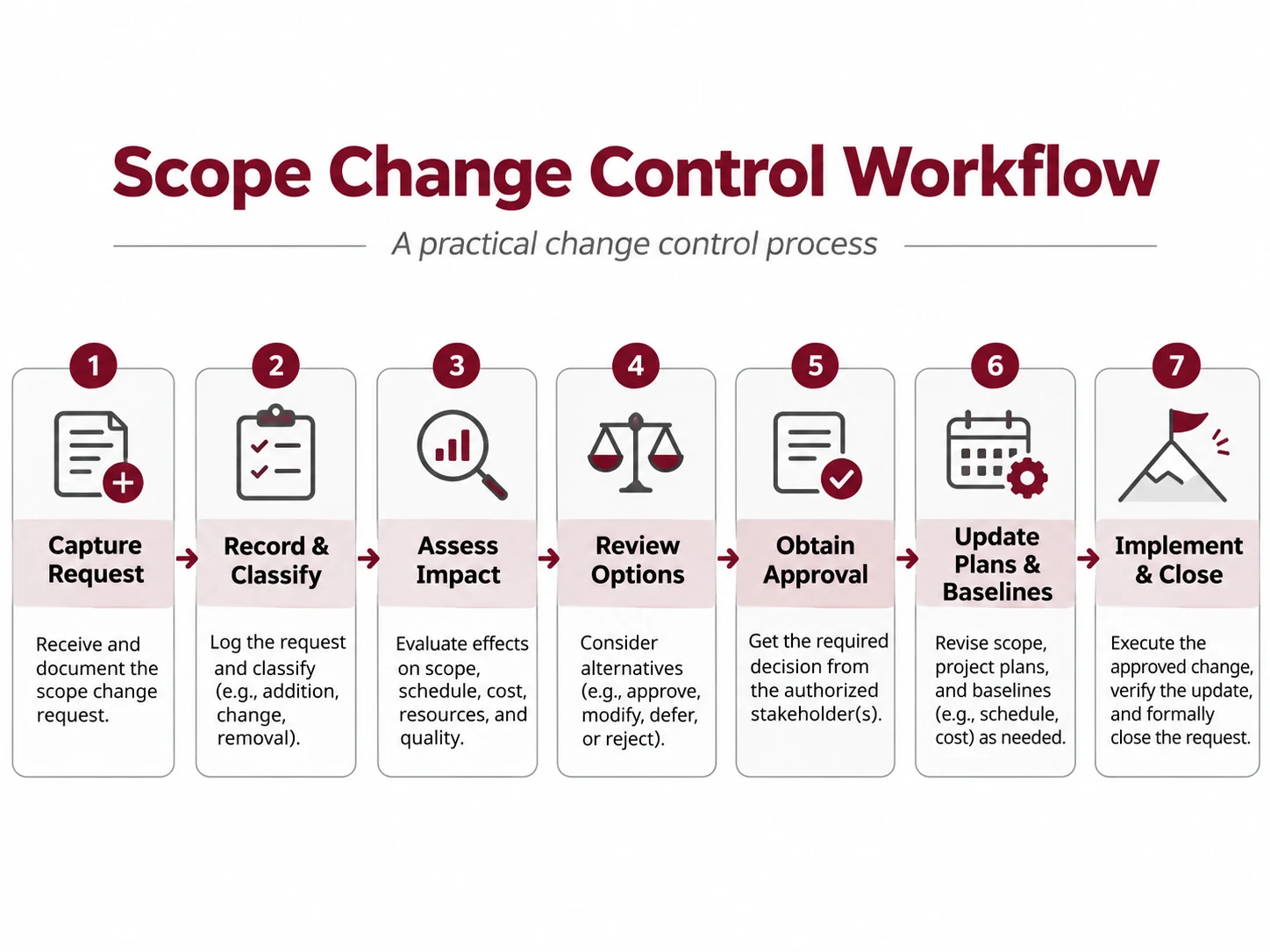
Every material scope change should be documented.
A request might arrive by email, in a meeting or through a project management tool. The communication method is less important than creating a reliable record.
At a minimum, capture:
The request should be clear enough for the project manager and relevant specialists to assess.
A vague instruction such as “improve the reporting system” is difficult to estimate.
A better request would be:
“Add a dashboard showing monthly sales, regional revenue and overdue customer invoices, with access restricted to finance managers.”
That provides a more useful starting point for analysis.
Add the request to a central change log.
Give it a unique reference number, such as CR-001, and record the date, requester and current status.
Then determine what type of change it is.
For example:
| Type | Example |
|---|---|
| Scope | Adding a new feature or deliverable |
| Design | Changing an approved equipment specification |
| Schedule | Moving a contractual milestone |
| Cost | Increasing the approved project budget |
| Quality | Changing acceptance or performance requirements |
| Compliance | Updating work to meet a new requirement |
Some requests affect more than one category.
Also check whether the request genuinely changes the approved scope. It might be a clarification, defect correction or task already covered by the existing agreement.
A defect in something the team was already required to deliver does not automatically justify additional scope or payment.
This distinction can be particularly important when working with suppliers and clients.
This is often the most important step.
Before agreeing to a change, assess how it affects the wider project.
At a minimum, examine six areas.
| Area | Questions to ask |
|---|---|
| Scope | What additional or revised work is required? |
| Schedule | Will tasks, dependencies or milestones change? |
| Cost | What additional labour, materials or supplier costs are expected? |
| Resources | Do we have the right people and capacity? |
| Quality | Will acceptance criteria, testing or performance be affected? |
| Risk | What new risks or uncertainties does the change introduce? |
Also consider contractual obligations, procurement, regulatory compliance and business benefits where relevant.
For schedule changes, review the activities affected and their dependencies. If the change affects a critical-path activity, even a relatively small amount of new work may delay the overall project.
For risk-related impacts, see our guide on Project Risk Management: How to Identify, Assess and Control Risks.
Imagine a business has approved a website project with a budget of £15,000 and a six-week delivery schedule.
During development, the client requests a new booking feature.
The development team estimates the following:
| Additional activity | Estimated effort |
|---|---|
| Requirements and design | 8 hours |
| Development | 24 hours |
| Testing and fixes | 8 hours |
| Total additional effort | 40 hours |
At an illustrative blended rate of £75 per hour, that represents £3,000 of additional labour.
The team also estimates that the feature could extend the delivery schedule by four working days because some work depends on earlier development and testing.
The impact assessment should therefore explain:
These figures are illustrative. A real estimate would depend on the technical requirements, available resources, contracts and project schedule.
The client can now assess whether the additional feature is worth the cost and delay.
Without that analysis, the team might accept the feature while still being held to the original budget and deadline.
A change request does not always lead to a simple yes-or-no decision.
There may be several workable options.
For our booking feature, the project manager could present:
Option A — Approve the full change
Increase the budget and revise the delivery date to include the complete feature.
Option B — Deliver a smaller version
Implement the essential booking functionality now and defer optional elements.
Option C — Replace existing scope
Remove or postpone a lower-priority feature to make room for the booking system, subject to a revised impact assessment.
Option D — Defer the request
Complete the current project as approved and deliver the booking feature in a later phase.
Option E — Reject the change
Continue with the approved scope if the additional value does not justify the cost, risk or disruption.
Showing realistic alternatives gives decision-makers a clearer understanding of the trade-offs.
The person who receives the request may not have authority to approve it.
A project manager might be permitted to approve small changes within agreed tolerances. Larger changes may require approval from the sponsor, client or a Change Control Board (CCB).
A Change Control Board is a designated group responsible for reviewing and deciding on change requests within its authority.
Smaller projects do not necessarily need a formal committee. A named project sponsor or authorised client representative may be sufficient.
The important point is that approval authority should be agreed in advance.
For example, a project might use the following decision rules:
| Change category | Illustrative approval route |
|---|---|
| Minor adjustment within approved scope and tolerances | Project manager |
| Change affecting agreed scope but within delegated limits | Project manager and authorised client representative |
| Change affecting contractual milestones or approved budget beyond tolerances | Sponsor or designated change authority |
| Major change affecting the business case | Project board or relevant governance authority |
These are examples, not universal approval thresholds.
The rules must reflect the project’s governance structure, contract and risk exposure.
Record the outcome as approved, rejected or deferred, along with the approver, date and any conditions.
Once a change is approved, update the affected project documents and management systems.
These may include:
Depending on the project, this may require a formal revision to one or more baselines.
Keep a record of the original baseline and the approved revision. Otherwise, the team may lose the ability to explain why the project’s commitments changed.
Communicate the decision to everyone affected.
For example, if a design change delays equipment procurement, the procurement team, supplier, installation contractor and project sponsor may all need to be informed.
Approval is only part of the process.
Assign responsibility for implementing the change, track the associated tasks and confirm that the revised requirements have been met.
For a software feature, this may involve development, testing and user acceptance.
For an engineering modification, it may involve revised drawings, procurement updates, installation inspections and commissioning checks.
After completion, update the change log with the implementation status and closure date.
The change should be traceable from its original request through approval to completion.
A business does not need complex software to begin controlling changes.
A simple, consistent form is enough for many smaller projects.
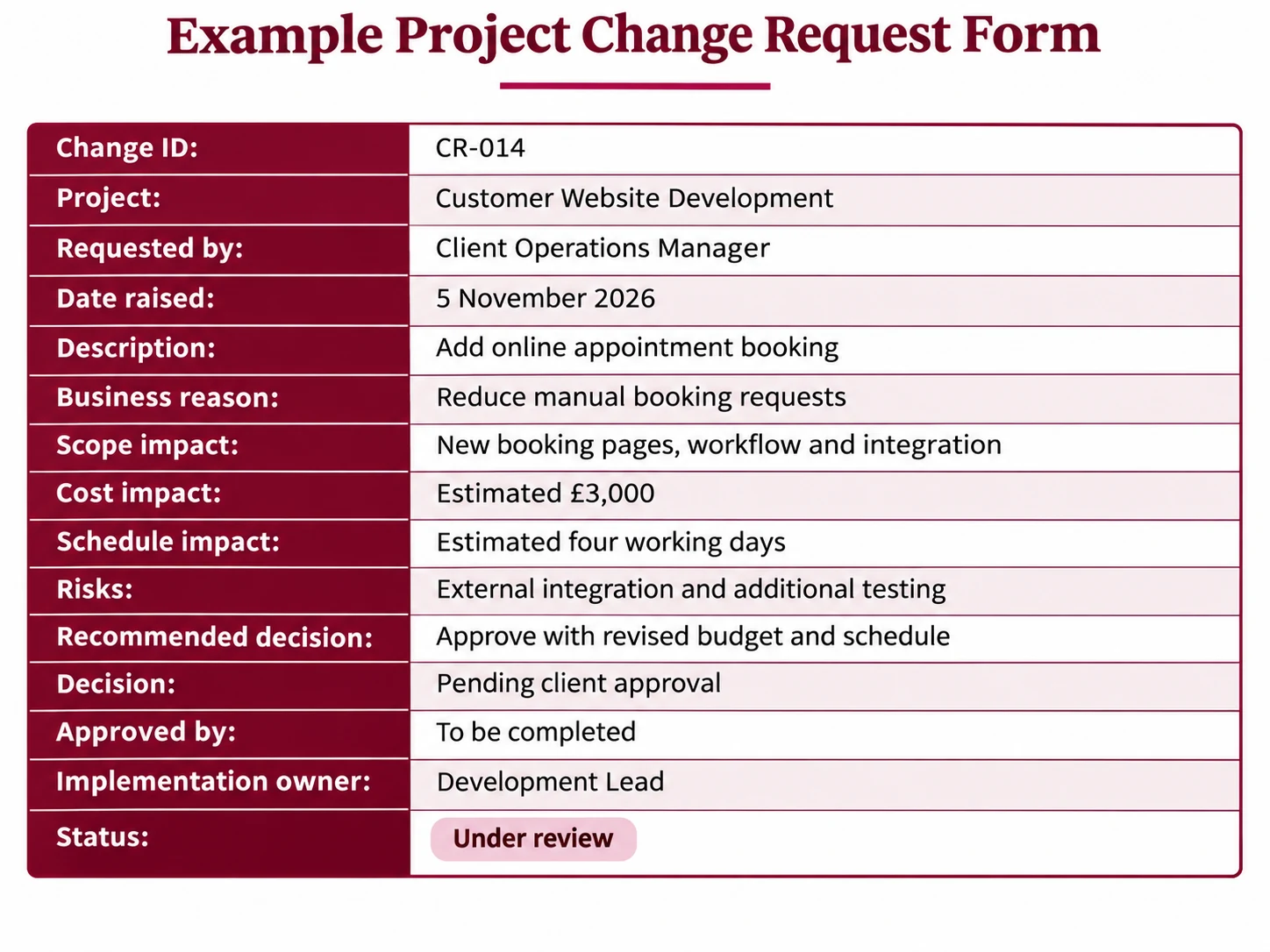
Here is an illustrative example.
| Field | Example |
|---|---|
| Change ID | CR-014 |
| Project | Customer Website Development |
| Requested by | Client Operations Manager |
| Date raised | 5 November 2026 |
| Description | Add online appointment booking |
| Business reason | Reduce manual booking requests |
| Scope impact | New booking pages, workflow and integration |
| Cost impact | Estimated £3,000 |
| Schedule impact | Estimated four working days |
| Risks | External integration and additional testing |
| Recommended decision | Approve with revised budget and schedule |
| Decision | Pending client approval |
| Approved by | To be completed |
| Implementation owner | Development Lead |
| Status | Under review |
This form can be used in a spreadsheet, Word document or project management platform.
What matters is that everyone uses the same process and understands where to find the latest decision.
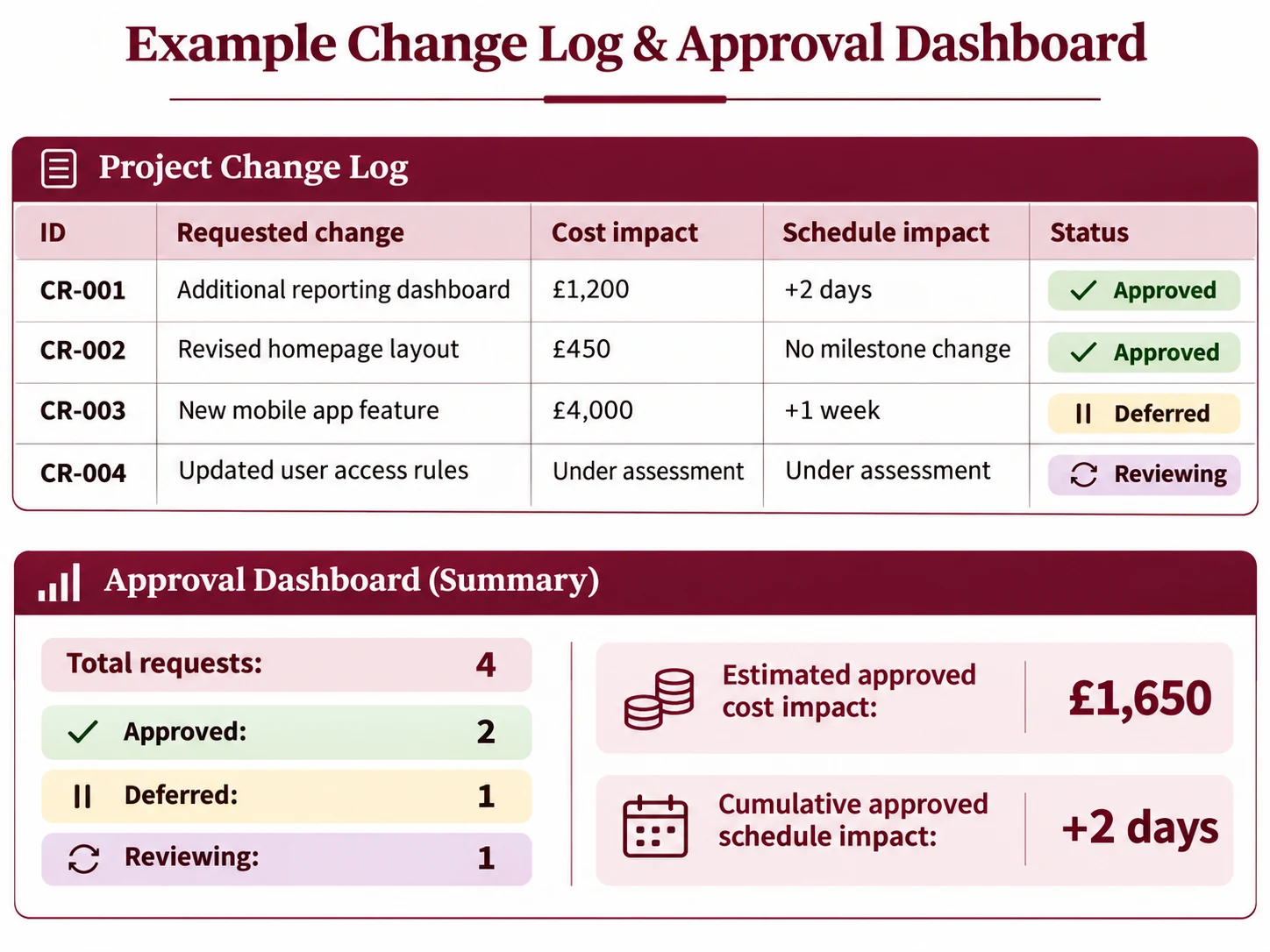
A change log gives the project manager a consolidated view of requests and decisions.
For example:
| ID | Requested change | Cost impact | Schedule impact | Status |
|---|---|---|---|---|
| CR-001 | Additional reporting dashboard | £1,200 | +2 days | Approved |
| CR-002 | Revised homepage layout | £450 | No milestone change | Approved |
| CR-003 | New mobile app feature | £4,000 | +1 week | Deferred |
| CR-004 | Updated user access rules | Under assessment | Under assessment | Reviewing |
A useful log may also include requester, decision owner, submission date, approval date, implementation owner and supporting documents.
Review the log regularly at project meetings.
Pay attention to cumulative impacts. Several changes may each be small, yet collectively increase the budget or extend the schedule significantly.
The change control process should reflect the project’s delivery approach.
In a predictive project, requirements and milestones are often defined in considerable detail before execution.
Changes to the approved scope may require formal impact assessment and approval before the baseline is revised.
This is particularly useful when work involves contracts, procurement or sequential dependencies.
In Agile delivery, changing priorities may be managed through a product backlog.
The Product Owner can order backlog items according to value and need, within the responsibilities defined by the chosen framework.
For example, a stakeholder may request a new feature. The team can discuss its value, size and dependencies before deciding when it might be delivered.
However, Agile does not eliminate contractual or governance obligations.
A request that changes the agreed funding, delivery commitment, contractual scope or other controlled baseline may still require formal approval.
Hybrid projects often need both approaches.
A CRM implementation might have a fixed implementation budget and contractual launch milestone, while allowing dashboard features to be developed iteratively.
The project manager needs clear rules distinguishing decisions that can be made through backlog prioritisation from changes that require project-level approval.
For a fuller explanation, read Agile vs Waterfall vs Hybrid: How to Choose the Right Project Approach.
Change control becomes easier when the project has strong foundations.
Document the intended deliverables, exclusions, constraints and acceptance criteria.
Avoid ambiguous requirements where possible.
For example, “create a user-friendly dashboard” leaves considerable room for interpretation.
A more useful requirement identifies what the dashboard should display, who will use it and how acceptance will be confirmed.
Agree on approval authority before delivery begins.
This reduces the risk of team members acting on informal instructions from someone who cannot authorise extra work.
Make sure clients and internal departments know how to submit a request and what happens next.
A process that nobody understands will rarely be followed consistently.
Include a change-log review in project meetings.
This keeps unresolved requests visible and helps the team identify growing pressure on the budget or schedule.
A project may absorb one small adjustment without difficulty.
Ten small adjustments can be a different matter.
Track both the individual impact of each change and the combined effect on the project.
Store approved requirements, change decisions, drawings, schedules and documents in clearly identifiable locations.
When several versions are circulating, people may accidentally work from outdated information.
Digital tools can make the process more consistent.
For example, a business using ClickUp, Asana or another task management system could establish a dedicated change request workflow.
A basic configuration might include:
New Request → Initial Review → Impact Assessment → Awaiting Approval → Approved / Rejected / Deferred → Implementation → Closed
Each request could contain:
Automation can help notify reviewers, flag overdue decisions and update dashboard information.
However, the system should not automatically approve a change simply because its form has been completed.
Approval remains a governance decision.
A software platform also needs to reflect actual contractual and management authority. A button labelled “Approved” is useful only when the right person has made the decision.
If your business is moving away from manual spreadsheets and disconnected email approvals, our article on How to Digitalise Project Management Workflows provides a useful starting point.
Even organisations with a formal change procedure can run into difficulties.
Starting work before approval. A team begins a requested change to avoid delaying the client conversation. Later, the request is rejected or the additional cost is disputed.
Assessing only the direct task. The team estimates development or installation hours but overlooks documentation, testing, procurement and dependent activities.
Failing to update the baseline. A change is approved, but project reports still compare progress against outdated commitments.
Treating every request as equally important. A minor clarification receives the same approval process as a major contractual variation, slowing decisions unnecessarily.
Ignoring contractual requirements. A manager assumes internal approval is sufficient even though the contract requires a formal variation or written client authorisation.
Losing track of approved changes. The change register shows that a request was approved, but nobody has been assigned responsibility for delivery.
These problems can be reduced through clear authority, consistent records and proportionate review procedures.
Use the following checklist before implementing a material change:
This checklist can be adapted for an internal procedure, a client delivery framework or a project management software workflow.
Scope change management is the process of assessing and controlling modifications to the agreed work and deliverables of a project. It typically involves recording a request, reviewing its impact, obtaining a decision and updating project plans when necessary.
A scope change can be formally reviewed and approved. Scope creep refers to uncontrolled expansion of project work without appropriate adjustments or governance.
Approval depends on the project’s governance arrangements. The project manager may have delegated authority for minor changes, while significant changes may require approval from a sponsor, client or Change Control Board.
A change request should describe the proposed modification, the reason for it, the affected work, its anticipated cost and schedule implications, relevant risks and the approval decision.
Yes. Agile teams can adjust priorities, but they still need to manage expectations, resources, contractual commitments and overall project objectives. Uncontrolled additions can create delivery problems in any methodology.
Not necessarily. A change request proposes a modification for evaluation. A change order is often a contractual instrument used to authorise a variation, particularly in construction and supplier contracts. Exact meanings depend on the contract and industry.
Project change control manages changes to approved project baselines or deliverables. Organisational change management focuses more broadly on helping people and organisations adopt a new way of working.
Scope changes are a normal part of project delivery.
A client may identify a better solution. A technical team may discover an important constraint. Business priorities may change before the project is completed.
The challenge is to understand what each request means for the project’s commitments.
A good project scope change management process makes requests visible, assesses their consequences and gives the appropriate people enough information to make decisions.
Start with an agreed scope baseline. Record proposed changes. Assess their impact on cost, schedule, resources, quality and risk. Obtain the necessary approval, then update the project plan and follow the change through to completion.
The process should be proportionate to the size and complexity of the project. A small business may need only a shared form and change log. A large engineering or IT programme may require formal change authorities, contractual records and detailed schedule analysis.
Both can benefit from the same basic discipline: understand the change before committing to it.
At KAFA Consultancy, we help businesses establish practical project management systems, improve workflows and manage delivery with clearer processes and reporting.
Whether you’re dealing with uncontrolled scope changes, unclear approvals or disconnected project records, we can help you review your current approach and develop a system that works for your team.
Our support includes project planning and scheduling, workflow design, change control processes, project reporting and digital project management systems.
Explore KAFA Consultancy’s Project Management & Automation Services.
Compare Agile, Waterfall and Hybrid project management with practical examples. Learn their differences, advantages and how to choose the right approach.
Read insightLearn project risk management with practical examples, a sample risk register and simple ways to identify, assess and control risks before they cause delays.
Read insightLearn how to digitalise project management workflows, reduce manual work and improve project visibility with practical steps, tools and automation examples.
Read insight