How to Manage Scope Changes Without Losing Control of Your Project
Learn how to manage project scope changes with a practical change control process, impact assessment, approval workflow and change request example.
Read insightCompare Agile, Waterfall and Hybrid project management with practical examples. Learn their differences, advantages and how to choose the right approach.
A software company is developing a new mobile application. The client knows what the app should do, but several features still need to be tested with users.
Should the team plan everything before starting development? Or should they build the app in smaller releases and improve it through feedback?
Now consider a company installing a cooling system in an industrial building. Equipment must be designed, approved, purchased and installed in a specific sequence. Changing the design halfway through installation could be expensive.
Would the same project management approach work for both?
Probably not.
This is where the Agile vs Waterfall vs Hybrid discussion becomes important. Each approach has its strengths. The best choice depends on the project, its requirements, the people involved and how much uncertainty the team is dealing with.
In this guide, we’ll look at how these approaches work, where they fit best and how to choose one for your next project.
The main difference is how the work is planned, delivered and adjusted when requirements change.
Waterfall, often described as a predictive approach, follows a planned sequence of phases. The team usually defines requirements early and manages work against an agreed plan.
Agile uses an adaptive approach. Teams develop and review work in smaller increments. Feedback helps them decide what to improve or deliver next.
Hybrid combines predictive and adaptive practices. Some parts of the project follow a detailed plan, while others allow greater flexibility.
| FeatureWaterfallAgileHybrid |
|---|
| PlanningDetailed planning earlyPlanning is refined regularlyOverall plan with adaptive delivery where useful |
| RequirementsGenerally stableMay evolve during deliverySome fixed, others flexible |
| DeliveryPlanned phasesFrequent increments or iterationsCombination |
| ChangesFormal change controlPrioritisation and replanningDepends on project governance |
| Customer feedbackUsually at planned review pointsFrequent feedbackAt milestones and during iterations |
| Common useWell-defined engineering and installation workEvolving software and digital productsIT implementation and business transformation |
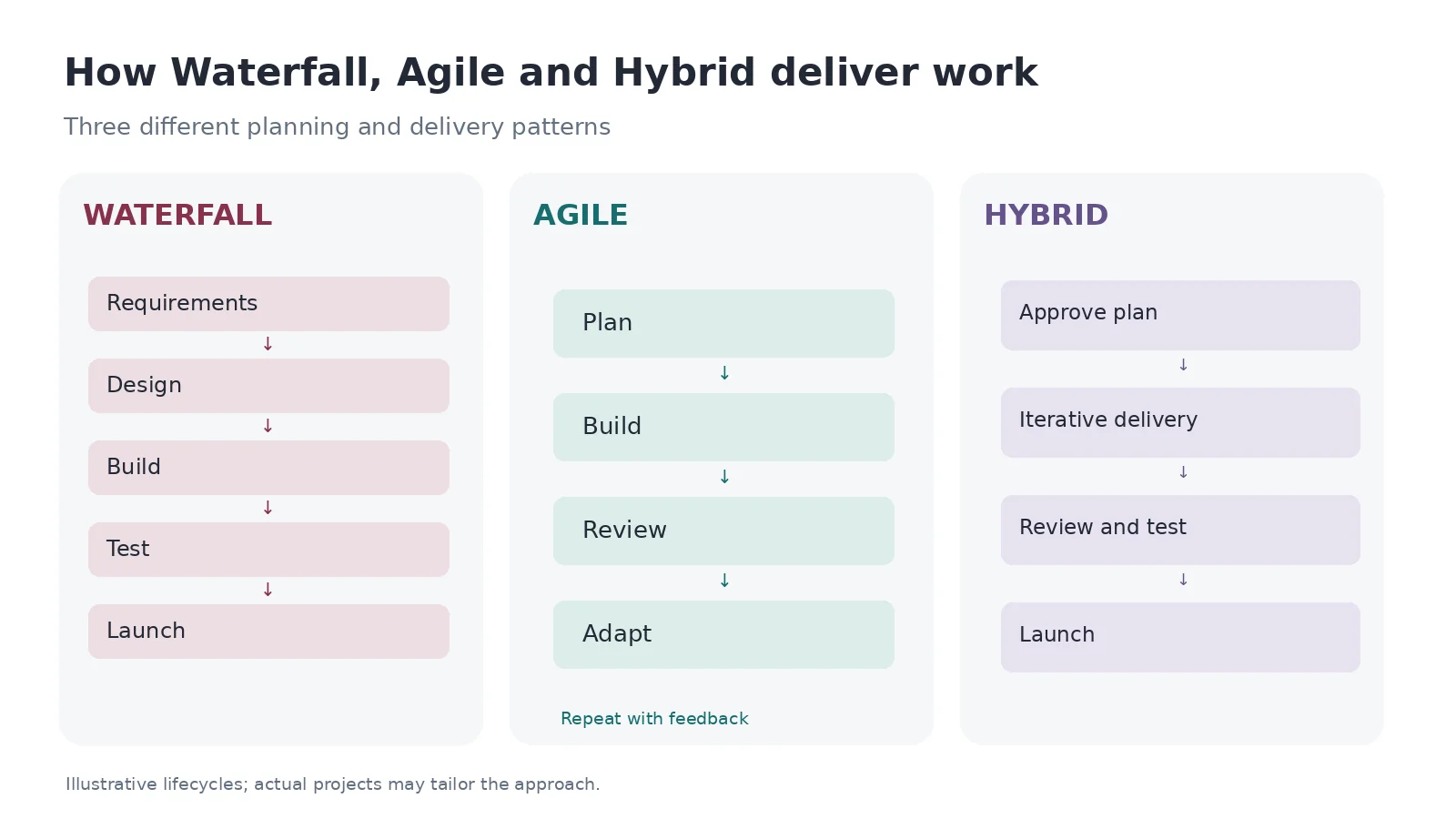
These are general patterns. Real projects may use different combinations of practices.
Imagine an engineering company installing a new air-conditioning system in a commercial building.
Before installation begins, the team needs approved designs, equipment specifications, load calculations, materials and a construction schedule.
Several activities depend on earlier work.
Equipment must arrive before it can be installed. Installation may depend on completed building work. Testing and commissioning require the relevant systems to be ready.
A predictive approach helps the project manager coordinate these activities.
A typical Waterfall life-cycle might follow:
Requirements → Design → Implementation → Testing → Handover
The project manager develops a schedule, identifies dependencies and agrees on important milestones.
For example, a Gantt chart can show when design approval, procurement, installation and commissioning are expected to happen.
If equipment delivery is delayed, the team can assess which activities will be affected.
Waterfall is worth considering when:
It is common in engineering and construction, but it can also suit some IT projects.
For example, a company replacing standard equipment across several offices may have well-defined requirements and a predictable deployment process.
A heavily sequential approach can be difficult when requirements are uncertain.
Suppose a software company completes months of development before showing the product to users.
During testing, customers discover that an important feature doesn’t meet their needs.
Correcting it may require considerable rework.
Waterfall projects can include testing, reviews and approved changes throughout delivery. However, projects with frequent uncertainty may benefit from a more adaptive approach.
Let’s return to our mobile application.
The client wants customers to book appointments, make payments and receive notifications.
The overall business objective is clear, but some details are uncertain.
Will customers prefer a calendar view? What should the booking screen display? Which notifications will be useful?
Instead of finalising every detail at the beginning, the development team could build a small working version and gather feedback.
This is where Agile becomes useful.
Agile delivery uses regular feedback and adaptation.
A software team might:
The process continues as the product develops.
The Agile Manifesto emphasises customer collaboration, frequent delivery and responding to change.
Scrum is a framework often used in Agile software development.
It includes the Product Owner, Scrum Master and Developers. It also defines events such as Sprint Planning, Daily Scrum, Sprint Review and Sprint Retrospective.
Work takes place within Sprints of one month or less.
At the end of each Sprint, the team can inspect the results and adapt its plans.
The official Scrum Guide explains the framework in detail.
Agile and Scrum are related, but they are not the same thing. Scrum is one framework that can support an Agile approach. Teams may also use Kanban or other practices.
Agile is useful when:
Software development, digital products and experimental services often have these characteristics.
Agile becomes harder when stakeholders cannot provide timely feedback or the team has little authority to make decisions.
It can also be difficult when the work depends on equipment, regulatory approvals or activities that cannot be delivered in small increments.
Agile still needs planning, quality control, documentation and risk management.
It allows teams to adapt their plans as they learn more. It doesn’t remove the need for project control.
Many projects contain both predictable and uncertain work.
Imagine a company introducing a new Customer Relationship Management (CRM) system across several offices.
Management has approved a budget and a target implementation date.
Some activities are predictable. The company needs software licences, infrastructure preparation, data migration and employee training.
Other activities require flexibility. The business may not know which dashboard layout employees will prefer or how some features should work.
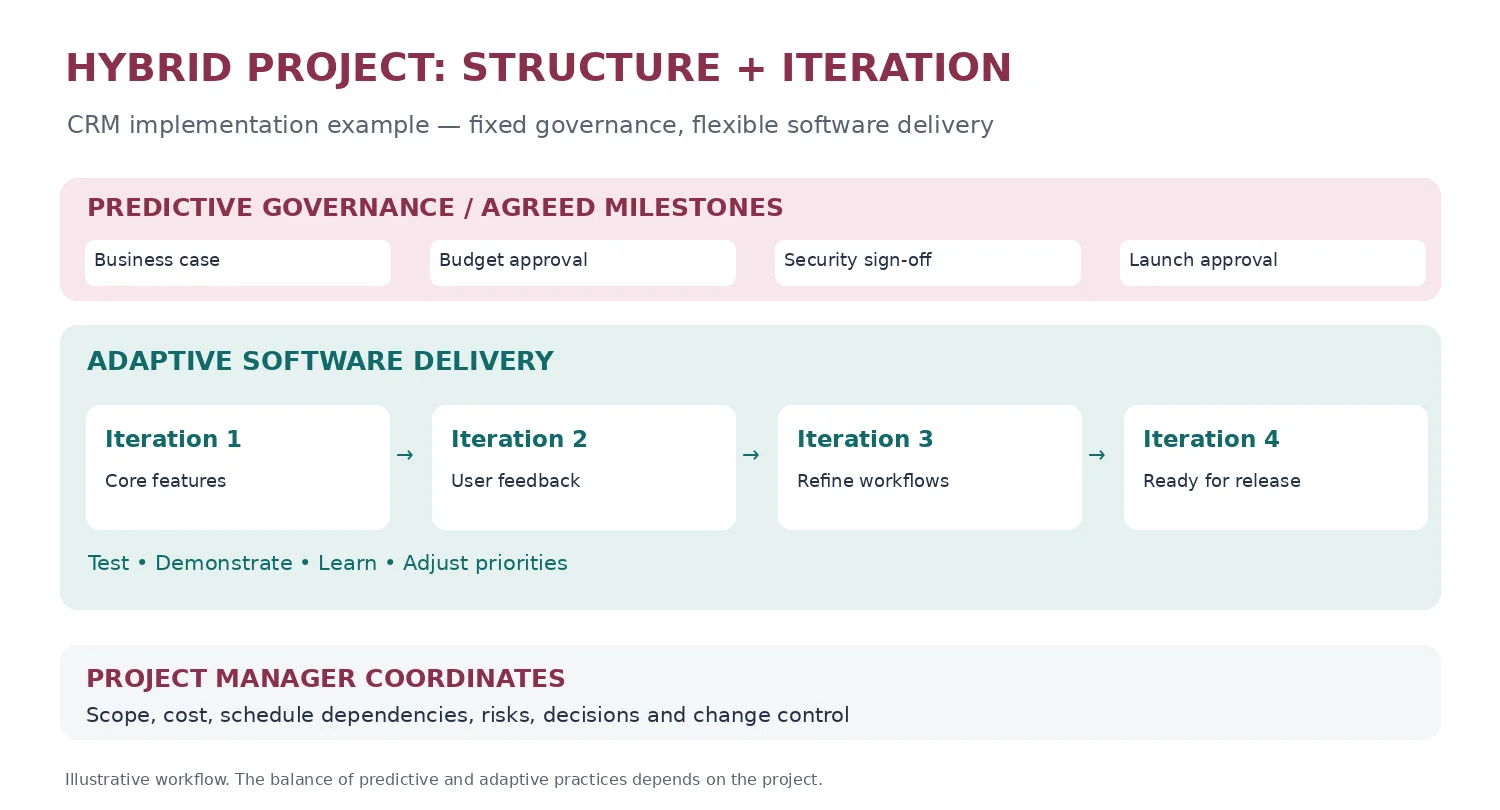
A Hybrid approach can accommodate both.
The project manager establishes the overall schedule, budget, milestones and governance arrangements.
Meanwhile, the software team configures and tests features through shorter iterations.
For example:
| Project activityPossible approach |
|---|
| Business case and budget approvalPredictive |
| Infrastructure procurementPredictive |
| Software configurationAgile / Iterative |
| Dashboard developmentAgile / Iterative |
| Data migrationPlanned stages with repeated testing |
| User feedbackAgile |
| Final deploymentControlled release and approval |
This gives the organisation oversight while allowing the delivery team to learn and improve the solution.
Hybrid can work well when:
The Association for Project Management’s life-cycle guidance recognises hybrid life-cycles that combine different approaches.
Hybrid requires clear coordination.
For example, an Agile development team might change a feature that affects a supplier’s fixed-price contract.
The change may appear small to the developers, but it could increase costs or delay another activity.
The project manager needs clear rules about which decisions the team can make and which changes require formal approval.
Before choosing Agile, Waterfall or Hybrid, I would ask five questions.
If the business knows exactly what must be delivered, predictive planning may be suitable.
If the requirements are uncertain, Agile may help the team learn through feedback.
If some requirements are fixed and others still need exploration, Hybrid may be worth considering.
Changing a software screen during development may be relatively straightforward.
Changing equipment specifications after procurement or installation can be expensive.
Projects with high rework costs often need stronger upfront planning, design reviews and approvals.
A digital product might release useful features gradually.
Some physical projects need a complete system before customers can use the final result.
This affects whether incremental delivery is practical.
Agile relies on frequent feedback and timely decisions.
If clients and users are unavailable for regular reviews, the team may struggle to refine requirements.
Some projects require formal reporting, contractual approvals, strict documentation and audit records.
These requirements do not automatically rule out Agile.
They need to be considered when selecting and tailoring the delivery approach.
| If your project has…Consider… |
|---|
| Stable requirements and sequential activitiesWaterfall / Predictive |
| Evolving requirements and regular user feedbackAgile / Adaptive |
| Fixed budgets and milestones with uncertain product detailsHybrid |
| Complex installation and procurement dependenciesPredictive, possibly with iterative design work |
| A digital product needing continuous testing and improvementAgile |
| Formal governance with iterative software deliveryHybrid |
These are starting recommendations. The final choice should reflect the project and the organisation delivering it.
Yes.
This is an important distinction because PRINCE2, Agile and Waterfall are not all the same type of framework.
PRINCE2 is a project management method that defines principles, practices, processes, roles and governance arrangements.
Waterfall and Agile describe broad approaches to how work is planned and delivered.
A business can apply PRINCE2 governance while using predictive, adaptive or hybrid delivery practices.
For example, an IT project could use PRINCE2 for business justification, responsibilities, risk management and stage control while the development team uses Scrum.
PRINCE2 7 supports tailoring the management method to the project environment.
This makes it possible to maintain formal oversight without requiring every activity to follow a single delivery pattern.
One common mistake is choosing Agile simply because a project involves software.
Not every software project has uncertain requirements. A well-defined system replacement or migration may benefit from substantial predictive planning.
Another mistake is assuming Waterfall projects cannot change. They can, but changes usually need to be reviewed against the agreed scope, schedule and budget.
Some businesses also choose Hybrid without defining how the predictive and adaptive elements will work together.
This can create confusion between project management and delivery teams.
Finally, organisations sometimes spend too much time debating methodology while ignoring basic problems.
An Agile project can fail because responsibilities are unclear. A Waterfall project can fail because its schedule is unrealistic. A Hybrid project can fail because stakeholder decisions are delayed.
The approach matters, but the project still needs effective management.
You don’t always need to abandon the current method.
Start by identifying what isn’t working.
For example, a software project using a heavily predictive approach may struggle because users keep changing their requirements.
The project manager could introduce shorter development cycles and more frequent demonstrations for the remaining work.
Alternatively, an Agile team may be struggling with procurement deadlines or external approvals.
It might need a more structured overall schedule and clearer governance arrangements.
Before changing the delivery approach, assess the effect on contracts, budgets, existing commitments and the people involved.
Any major change should be discussed and approved through the appropriate project governance process.
Not always. Agile is generally useful when requirements evolve and regular feedback is available. Waterfall can be effective when requirements are stable and work follows a predictable sequence.
Hybrid project management combines predictive and adaptive practices. For example, a project may use fixed milestones and formal budget approvals while developing software in short iterations.
No. Scrum is a framework that can support Agile delivery. Agile refers to a broader set of values and principles.
Yes. It can suit software projects with clear requirements, predictable work and well-defined acceptance criteria.
PRINCE2 is a project management method that can work alongside different delivery approaches. It can be tailored for predictive, adaptive and hybrid environments.
Agile, Waterfall and Hybrid all have a place in project management.
Waterfall is useful when the work is relatively predictable and detailed planning is important.
Agile helps teams respond to uncertainty through feedback and incremental delivery.
Hybrid combines practices where the project needs both structure and flexibility.
Before choosing, look at the requirements, dependencies, cost of changes, stakeholder involvement and governance needs.
The best approach is the one that fits the work, the organisation and the results the project needs to achieve.
At KAFA Consultancy, we help businesses plan and manage projects across engineering, IT and digital environments.
Our project management services include project planning and scheduling, risk management, change control, workflow development, project reporting and digital project management systems.
If your organisation needs help selecting a project management approach or improving its delivery processes, we can review your requirements and help develop a practical solution.
Explore KAFA Consultancy’s Project Management & Automation Services
Learn how to manage project scope changes with a practical change control process, impact assessment, approval workflow and change request example.
Read insightLearn project risk management with practical examples, a sample risk register and simple ways to identify, assess and control risks before they cause delays.
Read insightLearn how to digitalise project management workflows, reduce manual work and improve project visibility with practical steps, tools and automation examples.
Read insight