
10 Project Management Workflows You Can Automate Using Modern Tools
Explore 10 project management workflows you can automate, from task assignment and deadline reminders to approvals, reporting and handover, with practical examples.
Read insightBring a delayed project back under control with a practical recovery plan. Learn how to find the causes, review the critical path and choose realistic recovery actions.

A supplier misses a delivery. An approval takes longer than expected. A task that should have finished last week is still open. Before long, the project is behind schedule.
The client wants a new completion date. The team suggests overtime. Management wants an immediate solution.
But speeding up work without understanding the delay can create more problems. It can increase costs, cause rework and put quality at risk.
A project recovery plan helps the team find the real problems and choose a sensible way forward. This guide explains how to recover a delayed project, with a worked engineering example, schedule recovery techniques and a template you can use.
A project recovery plan records the actions needed to bring a delayed or troubled project back under control. It explains what caused the delay, what work remains, who will take action and how progress will be checked.
A recovery plan may help the team meet the original deadline. Sometimes that is no longer realistic. In that case, the plan should support an approved, achievable completion date.
The aim is to restore confidence in the schedule and project decisions.
A revised schedule is only one part of this work. The recovery plan also covers resources, costs, risks, approvals and responsibilities. The Association for Project Management (APM) explains how project controls support monitoring and corrective action.
Common causes include unclear requirements, late approvals, supply problems, weak estimates, resource shortages, unexpected technical work and scope changes.
For example, a late design approval may delay a purchase order. The equipment then arrives late. Installation slips, followed by testing and commissioning.
The visible problem is late installation, but the earlier approval delay may be the root cause. This is why a recovery plan must look beyond the latest missed task.
For a wider discussion, see our article on why projects fail.
Start with facts. Review the approved baseline, latest schedule, completed work and remaining tasks. Confirm the status with the people responsible for delivery.
Do not rely only on percentage-complete figures. A task shown as 90% complete may still need a difficult test or final approval.
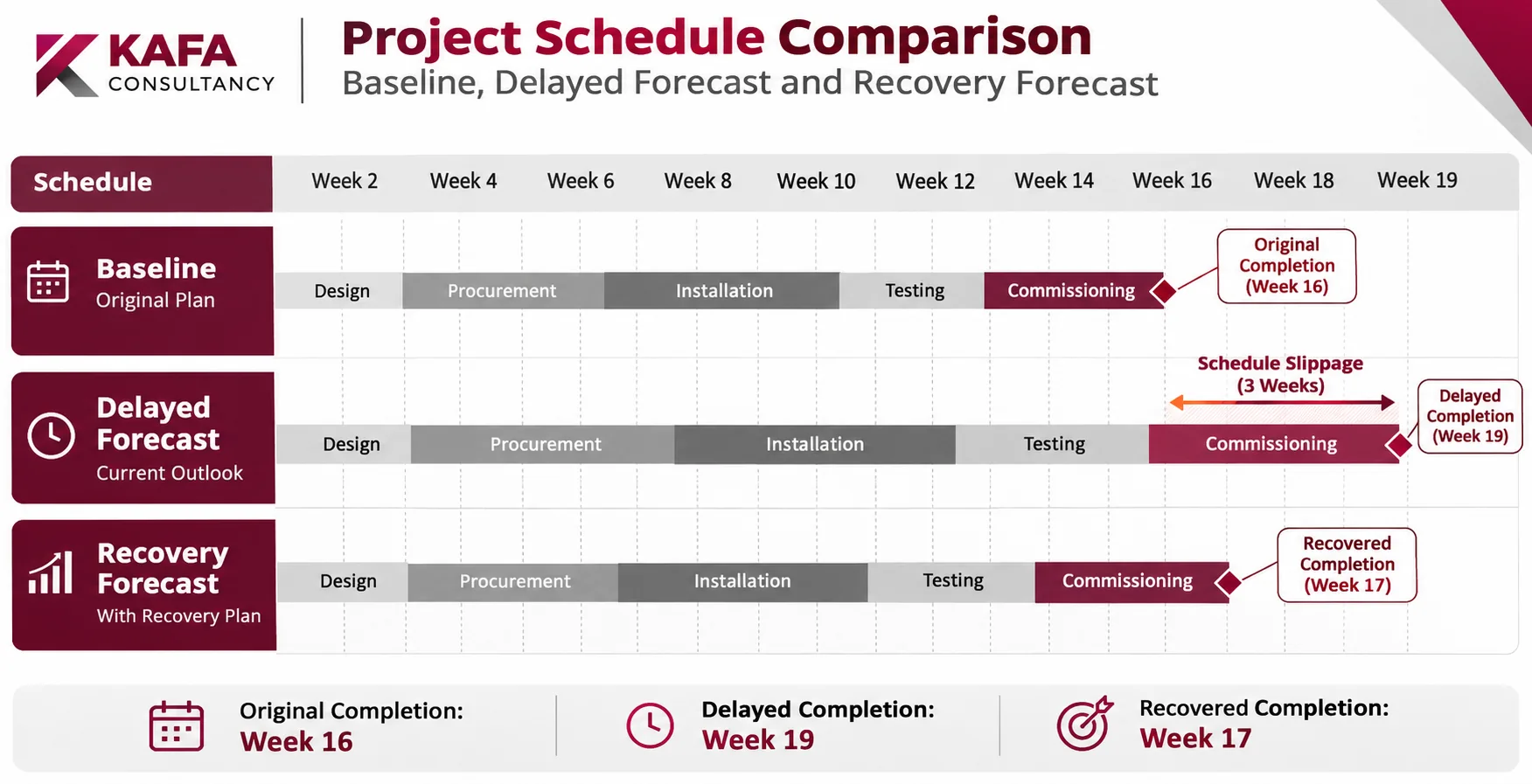
Compare three dates:
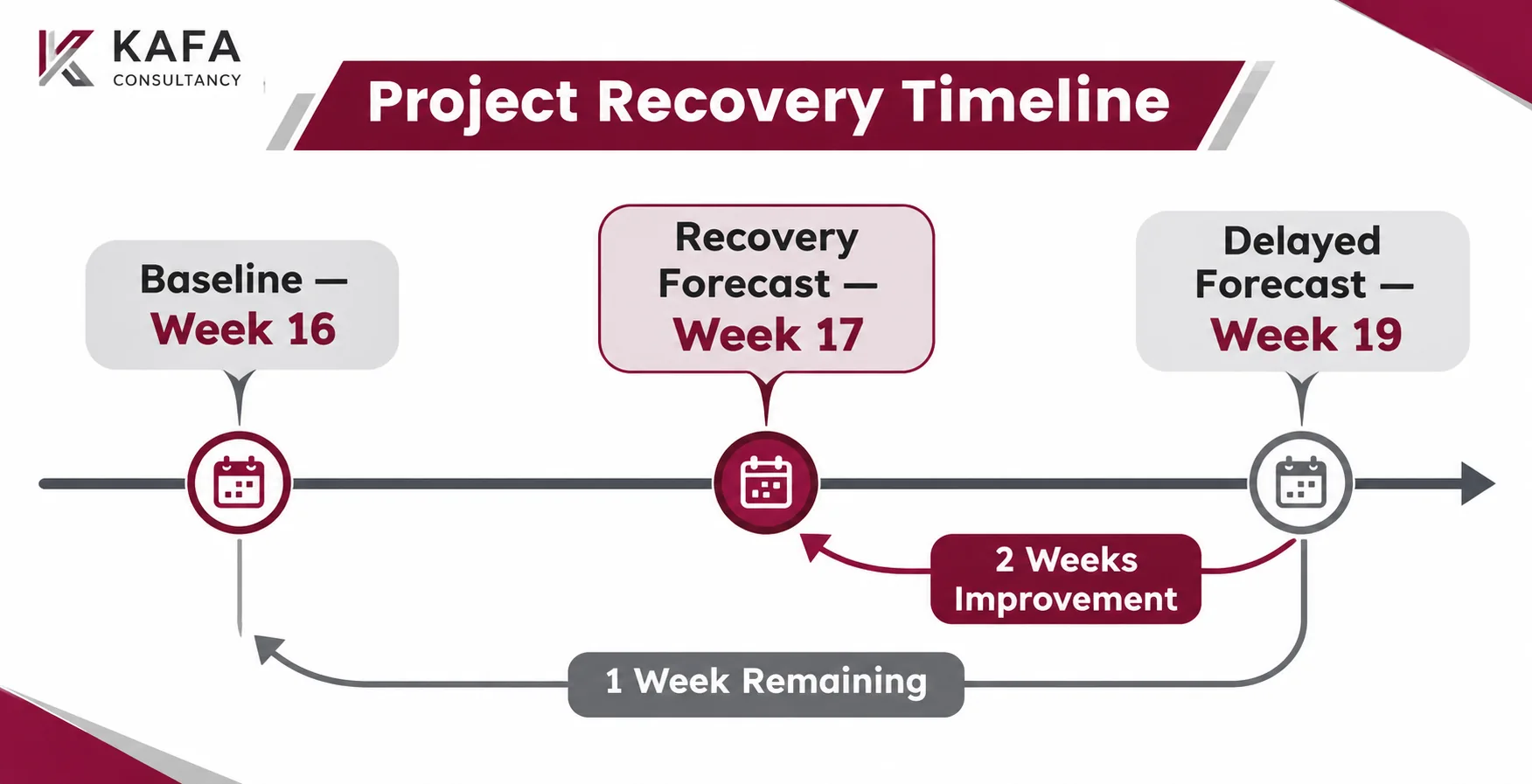
Suppose the original project deadline was Week 16. The updated forecast is Week 19. The project is now forecast to finish three weeks late.
That difference gives you the scale of the problem. It does not yet tell you which activities caused it or where time can be recovered.
Also review open issues, purchase orders, staffing, risks and outstanding decisions. Use one agreed status date so everyone is working from the same information.
Ask why each major activity is delayed. Speak to the relevant team members, suppliers and decision-makers.
A simple 5 Whys exercise can help:
| Question | Example answer |
|---|---|
| Why has installation not started? | The equipment has not arrived. |
| Why is delivery late? | The order was placed late. |
| Why was the order late? | The design was not approved. |
| Why was approval delayed? | Review comments remained open. |
| Why were comments still open? | Nobody had clear responsibility for closing them. |
The project may need an earlier equipment delivery, but it also needs a better approval process. Otherwise, the same issue could affect the next work package.
Record the causes separately from their effects. Use evidence where possible. Avoid turning the exercise into a search for someone to blame.
The critical path is the sequence of dependent activities that controls the earliest possible project finish date. It helps the project manager see where a delay matters most.
Imagine two remaining workstreams:
If mechanical installation controls final completion, adding staff to training will probably not bring the finish date forward.
Update the schedule with actual dates and realistic remaining durations. Check activity links, calendars, approvals and supplier commitments. Then recalculate the critical path.
Review near-critical activities too. An activity with little spare time may become critical after another part of the plan changes.
The APM scheduling guidance and the GAO Schedule Assessment Guide provide useful principles for maintaining reliable project schedules.
A recovery plan built on incorrect dependencies will produce unreliable dates, even if the Gantt chart looks convincing.
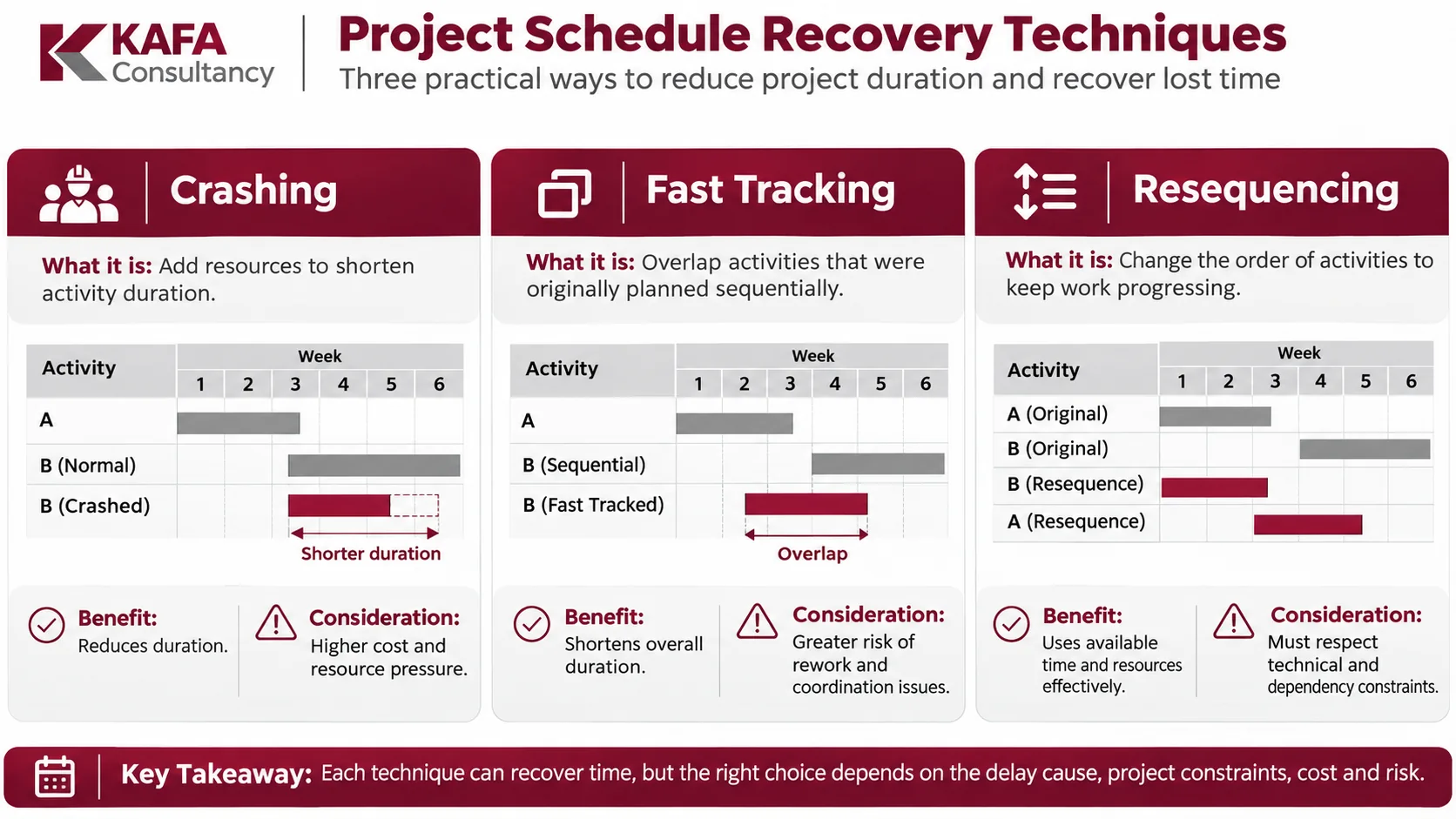
Once you know what is causing the delay, compare ways to recover time. The best choice depends on costs, available resources and technical constraints.
Crashing means adding resources or spending more to shorten an activity. A second installation crew may reduce a task from ten working days to seven.
It can help when the task affects project completion. But some activities cannot be shortened by adding people. More workers can also increase supervision costs and coordination problems.
Fast tracking means overlapping work that was planned in sequence. A software team might test finished modules while other features are still being developed.
This can save time, but it creates a risk of rework. Never overlap tasks in a way that bypasses required safety checks, quality controls or approvals.
Some independent tasks can be moved forward while a blocked activity waits. A project manager may also speed up decisions, resolve design queries or confirm earlier supplier deliveries.
These options can be useful when the main problem is waiting rather than the time needed to perform the work.
| Technique | Possible advantage | Main risk |
|---|---|---|
| Crashing | Shorter task duration | Higher cost and resource pressure |
| Fast tracking | Shorter overall schedule | Rework and coordination problems |
| Resequencing | Less idle time | Overlooking dependencies |
| Expediting approvals or supply | Removes waiting time | Uncertain external commitments |
Any change to agreed scope or contractual milestones may also need approval. See our scope change management guide.
Consider an illustrative industrial equipment installation project. The approved programme lasts 16 weeks.
In Week 8, the project manager finds that a late equipment order has affected installation. Testing and commissioning depend on that work.
The latest schedule now forecasts completion in Week 19, three weeks after the approved deadline.
The team reviews three options:
Options 2 and 3 together could recover two weeks, based on a new schedule assessment. That would move the forecast to Week 17.
| Recovery action | Responsible person | Target |
|---|---|---|
| Confirm revised equipment delivery | Procurement Lead | Week 8 |
| Approve any extra delivery costs | Project Sponsor | Week 8 |
| Arrange additional installation crew | Construction Manager | Week 9 |
| Bring forward independent site tasks | Site Manager | Week 9 |
| Prepare commissioning documents | Commissioning Lead | Week 10 |
| Update schedule and review critical path | Project Planner | Weekly |
Suppose the extra work and expedited delivery would cost £12,000. The sponsor must compare this cost with the effect of the delay on operations and contractual commitments.
The new Week 17 forecast is an improvement, but it is still one week later than the original plan. The project manager should report that clearly.
All figures in this example are hypothetical. A real construction project recovery plan needs confirmed resource availability, supplier dates and a validated schedule.
A recovery plan may change staffing, costs, supplier arrangements or delivery commitments. Confirm who can approve each decision.
Once approved, record the owners, target dates and expected results. Update the current schedule and any affected cost forecasts, risk records and contracts.
Keep the original baseline available. It shows what the project first committed to deliver. The updated forecast shows the latest expected finish. If a new baseline is formally approved, keep a clear record of why it changed.
Tell the client and project team what has been agreed. Include any conditions or decisions still outstanding.
A project recovery plan needs close follow-up. Hold short, regular reviews with the people responsible for the recovery actions.
Track both completed work and early warning signs. Useful measures include supplier delivery confirmation, closed approvals, critical activities completed, open issues and changes to the forecast finish date.
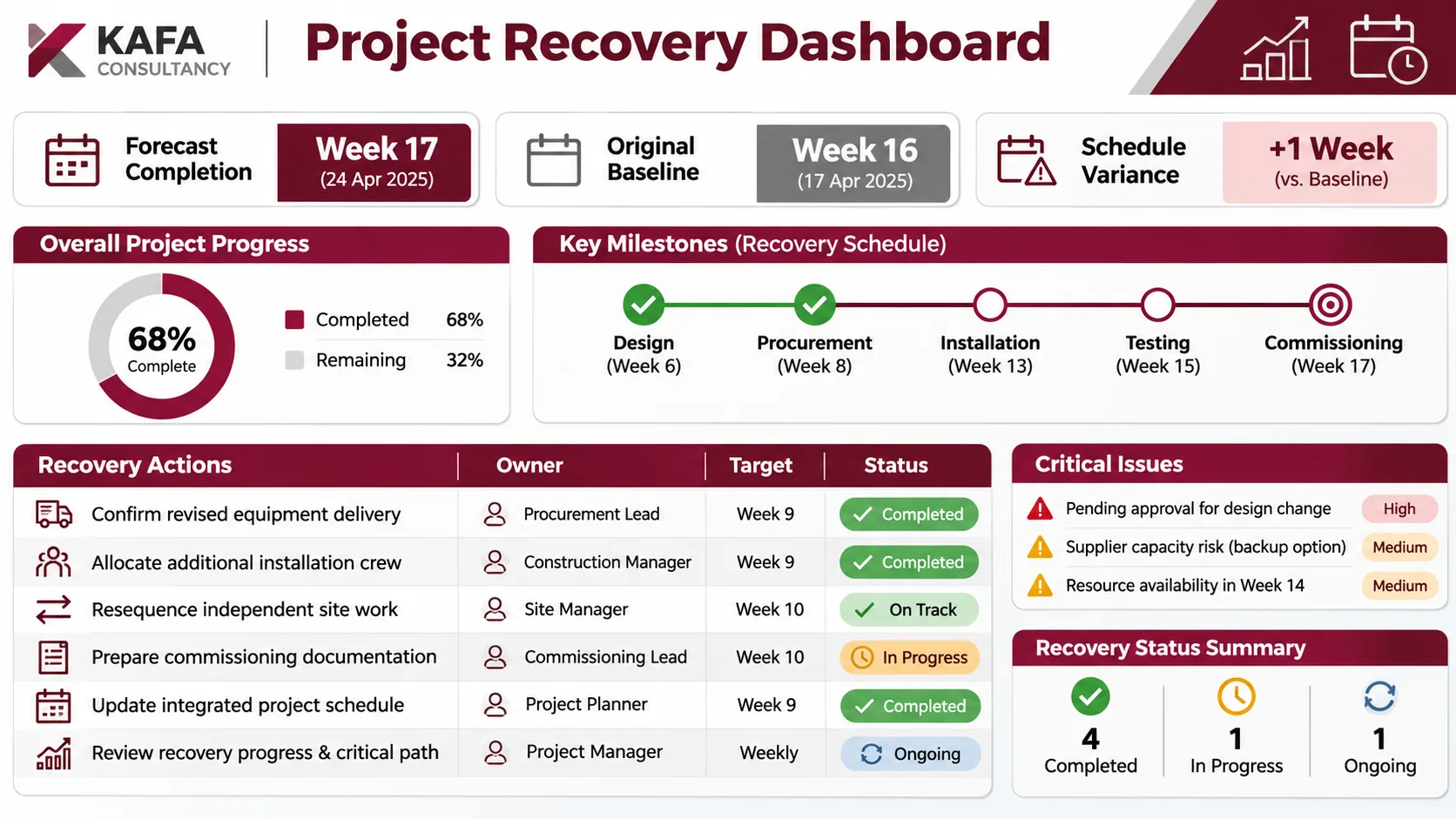
A simple project recovery dashboard could show:
| Measure | Example position |
|---|---|
| Approved baseline | Week 16 |
| Current recovery forecast | Week 17 |
| Equipment delivery | Confirmed |
| Extra installation crew | Mobilised |
| Critical issues | Two open |
| Recovery review | Weekly |
If an action slips, identify the reason and decide what needs to change. Do not wait until the next major milestone to discover that the recovery plan has stopped working.
The same steps apply to digital work. The main constraints may be software integrations, unclear requirements, testing or slow client feedback.
For example, a CRM implementation is four weeks late. The team should identify the features needed for launch, resolve critical integrations and check whether lower-priority reports can be delivered later.
Shorter reviews and clearer decisions may help. But testing, security and agreed acceptance criteria still matter.
A phased release can be useful if the client approves the revised commitments. Our guide to Agile, Waterfall and Hybrid explains how different delivery approaches handle planning and change.
For a small or medium-sized project, use this simple structure:
| Section | What to record |
|---|---|
| Current status | Baseline, actual progress and forecast finish |
| Causes of delay | Main issues and evidence |
| Critical activities | Work that affects final completion |
| Recovery actions | Tasks, owners and target dates |
| Cost and risk | Extra expense and possible consequences |
| Approval | Decision-maker and approval date |
| Monitoring | Review frequency and progress measures |
Your recovery objective should be specific. For example: Reduce a three-week forecast delay to one week by expediting equipment, adding installation capacity and preparing independent commissioning work in parallel.
Before approval, confirm that the dates are realistic, the team is available, risks are reviewed and any contract changes are addressed.
Adding people to the wrong tasks. More staff will not improve the finish date if the affected work is not driving completion.
Ignoring the cause. Overtime may hide a problem for a week, but unresolved approvals can cause further delays.
Overlapping unsafe or dependent work. Fast tracking must respect technical checks and required hold points.
Changing the baseline to hide a delay. Keep a clear record of original commitments and approved changes.
Assuming every promised delivery will happen. Confirm supplier and resource commitments before relying on them.
Ignoring the cost of acceleration. Compare the cost of recovery with the effects of finishing late.
It is a practical plan to control a delayed project. It records the causes, recovery actions, owners, costs, risks and new forecasts.
Confirm progress, find the causes, update the critical path and compare recovery options. Approve the chosen actions and review progress regularly.
Crashing adds resources or cost to reduce a task’s duration. Fast tracking overlaps tasks that were planned in sequence.
Yes, sometimes. Faster approvals, better sequencing and reliable supplier dates may remove delays without extra workers.
Present a realistic forecast and the available options. The sponsor or client can then approve a revised commitment where appropriate.
A delayed project needs accurate information and clear decisions. Start with the real status, find the causes and update the schedule. Focus recovery efforts on work that affects completion.
Compare the time saved against the cost and risk of each option. Then agree on a practical project recovery plan, give actions to named owners and monitor the results.
The original deadline may still be possible. If it is not, an honest and achievable revised date is better than another promise the team cannot meet.
At KAFA Consultancy, we help businesses improve project planning, scheduling, reporting and project controls across engineering, IT and digital work.
If your project is behind schedule, we can help assess its current position, review dependencies and develop a practical recovery approach.
Explore our Project Management & Automation Services.
Explore 10 project management workflows you can automate, from task assignment and deadline reminders to approvals, reporting and handover, with practical examples.
Read insightLearn how to manage project scope changes with a practical change control process, impact assessment, approval workflow and change request example.
Read insightCompare Agile, Waterfall and Hybrid project management with practical examples. Learn their differences, advantages and how to choose the right approach.
Read insight