10 Project Management Workflows You Can Automate Using Modern Tools
Explore 10 project management workflows you can automate, from task assignment and deadline reminders to approvals, reporting and handover, with practical examples.
Read insightCompare PRINCE2 and PMI’s PMBOK Guide, explore their practical applications, and learn how to choose or combine them for better project governance, planning and delivery.
A company is preparing to install new equipment across several industrial sites. Another business is planning a software implementation. Both need a clear project plan, defined responsibilities and a way to manage risks.
The project managers may use similar tools, but their organisations could follow different approaches.
One company may use PRINCE2 to define how projects are authorised, managed and controlled. Another may use PMI’s PMBOK Guide to develop its planning, scheduling and risk management practices.
This raises a common question: What is the difference between PRINCE2 and PMBOK, and which should you use?
Both provide recognised project management guidance. They also cover many of the same subjects. However, they serve different purposes.
PRINCE2 is a project management method. The PMBOK Guide is a body-of-knowledge guide and part of PMI’s project management standards.
Understanding this difference helps businesses select practices that suit their projects.
In this article, we’ll compare PRINCE2 and the PMBOK Guide, explain how they work in practice and look at how organisations can use them together.
PRINCE2 stands for Projects IN Controlled Environments.
It is a structured project management method that helps organisations establish clear roles, manage projects in stages and maintain business control.
The current version is PRINCE2 Project Management (Version 7), published by PeopleCert.
PRINCE2 provides guidance on how a project should be organised, directed and managed from initiation to closure.
It includes seven principles, seven practices and seven processes.
PRINCE2 uses seven principles to guide the application of its method:
These principles encourage teams to maintain a clear business purpose and apply governance that fits the project.
For example, managing by exception allows a project manager to work within agreed tolerances. If a forecast exceeds those tolerances, the matter is escalated to the appropriate authority.
This helps senior management focus on decisions that need its attention.
The seven practices cover business case, organising, plans, quality, risk, issues and progress.
These are areas that need attention throughout a project.
The seven processes provide a management structure from starting a project through to closure.
PRINCE2 also defines responsibilities for project direction, management and delivery.
A project board provides direction and key decisions. The project manager handles day-to-day management within agreed authority.
This structure is useful when several departments, suppliers or senior stakeholders are involved.
For official information, see PeopleCert’s PRINCE2 Project Management guidance.
The PMBOK Guide stands for A Guide to the Project Management Body of Knowledge.
It is published by the Project Management Institute (PMI).
The guide brings together recognised project management principles, practices and techniques.
Unlike PRINCE2, it does not prescribe one complete project management method that every organisation must follow.
Instead, it helps project managers understand the areas they need to manage and choose suitable practices.
The current edition is the PMBOK Guide, Eighth Edition, published in November 2025.
The eighth edition includes six core principles and seven project management performance domains.
The six principles address:
The seven performance domains cover:
| Performance domain | Main concern |
|---|---|
| Governance | Direction, decisions and accountability |
| Scope | Requirements and agreed project work |
| Schedule | Activities, dependencies and time |
| Finance | Costs, budgets and financial performance |
| Stakeholders | Engagement and expectations |
| Resources | People and other project resources |
| Risk | Uncertainty, threats and opportunities |
The guide also provides practical process guidance and discusses how to tailor project management to different situations.
This makes it relevant to predictive, Agile and Hybrid environments.
For details, see PMI’s official PMBOK Guide page.
The clearest distinction is how the two publications are intended to be used.
PRINCE2 provides a project management method. PMBOK provides broader knowledge and guidance for managing projects.
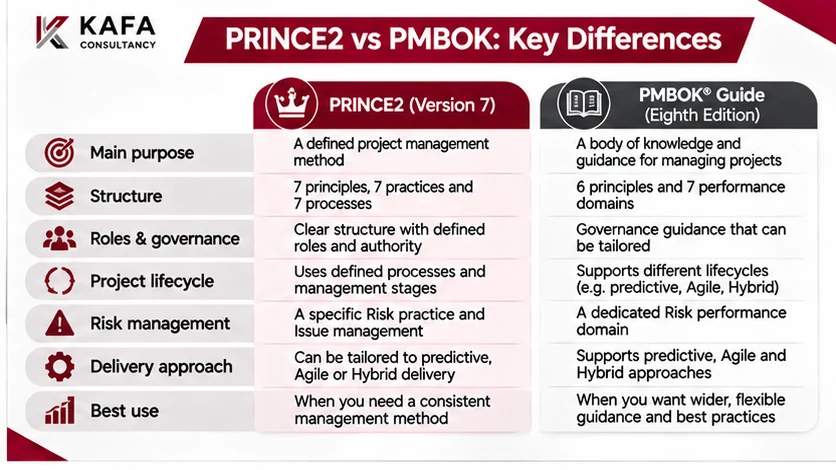
Here is a practical comparison.
| Area | PRINCE2 Version 7 | PMBOK Guide Eighth Edition |
|---|---|---|
| Main purpose | Provides a project management method | Provides principles, domains and practical guidance |
| Published by | PeopleCert | PMI |
| Structure | Principles, practices and processes | Principles, performance domains and process guidance |
| Roles | Defines a management structure and responsibilities | Provides guidance that can be applied within different structures |
| Project lifecycle | Uses defined management processes and stages | Supports different delivery lifecycles |
| Business justification | Explicit emphasis on continued justification | Focus on value and organisational outcomes |
| Governance | Defines how direction and control are organised | Provides governance guidance that can be tailored |
| Planning | Uses PRINCE2 planning and management practices | Offers wider planning and management knowledge |
| Agile compatibility | Can be tailored to adaptive delivery | Supports predictive, adaptive and Hybrid approaches |
| Best use | Establishing a consistent management method | Developing and improving project management capability |
These differences do not mean that one is more advanced or more effective.
The value of either approach depends on how well it is applied to the project.
Governance determines how decisions are made and who is accountable.
PRINCE2 gives organisations a defined governance structure.
It separates project direction from day-to-day management. It also uses agreed tolerances and escalation arrangements.
Imagine a company installing a new cooling system at a manufacturing facility.
The project manager handles the schedule, procurement coordination, risks and progress reporting.
However, the project may require a major budget increase because equipment specifications have changed.
Under a tailored PRINCE2 approach, the project manager would assess the issue and escalate it if the forecast exceeds agreed tolerances.
The appropriate project authority would then decide whether the change should proceed.
The PMBOK Guide also addresses governance and accountability.
However, it allows the organisation to select the governance arrangements that suit its needs.
Practical difference: PRINCE2 provides a defined method for organising project authority. PMBOK offers guidance that can support several governance structures.
Both approaches recognise the importance of planning.
PRINCE2 uses its Plans practice to help define how products will be delivered, what resources are needed and how work will be controlled.
It encourages planning at suitable levels, including the project and individual management stages.
The PMBOK Guide provides guidance across scope, schedule, finance and resource management.
These areas help project managers develop practical plans and monitor delivery.
A construction project needs a Work Breakdown Structure, activity schedule, resource plan and cost forecast.
The project manager may use Microsoft Project or Primavera P6 to calculate dependencies, identify the critical path and monitor schedule performance.
These planning techniques can support a project managed using PRINCE2.
The organisation could use PRINCE2 for stage approvals and reporting, while using PMI guidance to strengthen scheduling and project controls.
There is no need to choose one and reject the other.
For a related example, see our article on How to Recover a Delayed Project: A Practical Recovery Plan.
Risk management is important in both PRINCE2 and PMBOK.
PRINCE2 provides a Risk practice. It also includes an Issues practice for managing matters that require attention or decisions.
The PMBOK Guide covers risk as one of its seven performance domains.
Both encourage teams to identify uncertainty, assess its effect and respond appropriately.
A project depends on imported equipment.
There is a risk that delivery could be delayed.
The project manager records the risk, assesses its likelihood and impact, and considers possible responses.
These may include early procurement, supplier follow-up or an approved alternative.
If the supplier misses the agreed delivery date, the situation becomes an actual issue.
The project manager then needs to assess its effect on the schedule and decide what action is required.
PRINCE2 can help define how the issue is reported and escalated.
PMI guidance can help the team develop suitable risk analysis and response practices.
For more detail, read Project Risk Management: How to Identify, Assess and Control Risks.
Changes can affect scope, cost, schedule and quality.
PRINCE2 manages issues and changes through its defined management arrangements.
The level of authority depends on the nature of the change and the project’s agreed tolerances.
The PMBOK Guide addresses scope, governance and related management practices that help teams assess and control changes.
A company is implementing a CRM system.
Halfway through delivery, the client asks for an additional reporting dashboard.
The project manager needs to determine:
Both PRINCE2 and PMBOK can support these questions.
The main difference is how the project management system is established and applied.
A formal change procedure is particularly useful when the project involves contracts, approved budgets or external suppliers.
Our guide on Managing Project Scope Changes explains the process in more detail.
A common misunderstanding is that PRINCE2 is simply another name for Waterfall.
It isn’t.
PRINCE2 is a project management method. Waterfall is a predictive delivery approach.
A PRINCE2-managed project can use predictive, adaptive or Hybrid delivery practices.
For example, a software team may use Scrum for development while the wider organisation uses PRINCE2 for project direction, stage decisions and business justification.
The PMBOK Guide also supports different delivery approaches.
Its guidance can be tailored to the nature of the project and the level of uncertainty.
A business is implementing a CRM system across several departments.
It needs a fixed budget, an approved implementation plan and formal management reporting.
At the same time, the software team needs flexibility to test features with users.
The organisation could use:
This combination can work if decision-making responsibilities are clear.
For further guidance, see Agile vs Waterfall vs Hybrid: How to Choose the Right Project Approach.
Yes.
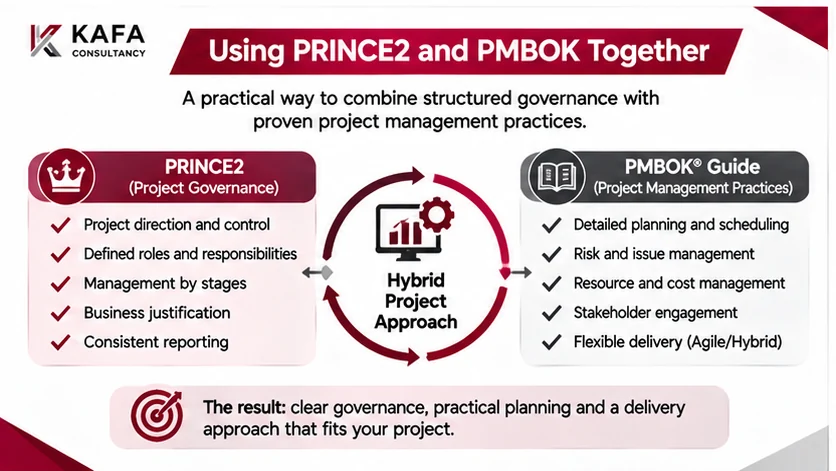
In fact, combining the two can be practical.
PRINCE2 can provide the overall project management method. PMI guidance can support the selection and improvement of planning, scheduling, risk and other management practices.
Consider a business with several ongoing projects.
Management wants consistent reporting, clear responsibilities and better control of budgets.
The company could adopt a simplified PRINCE2 management structure.
Each project would have a clear business justification, defined decision authority and agreed reporting arrangements.
The project managers could then use relevant PMI guidance to prepare schedules, manage resources, assess risks and monitor performance.
The organisation would not need to adopt every technique described in either publication.
It should choose practices that match its project size, complexity and level of risk.
Small businesses often need project management processes that are simple and affordable to maintain.
A business with five employees may not need the same management structure as an organisation delivering a large engineering programme.
However, it still needs clear responsibilities, an agreed scope, realistic deadlines and effective communication.
For a small business, I would recommend establishing a few essential controls:
These steps can be supported by either PRINCE2 or PMI guidance.
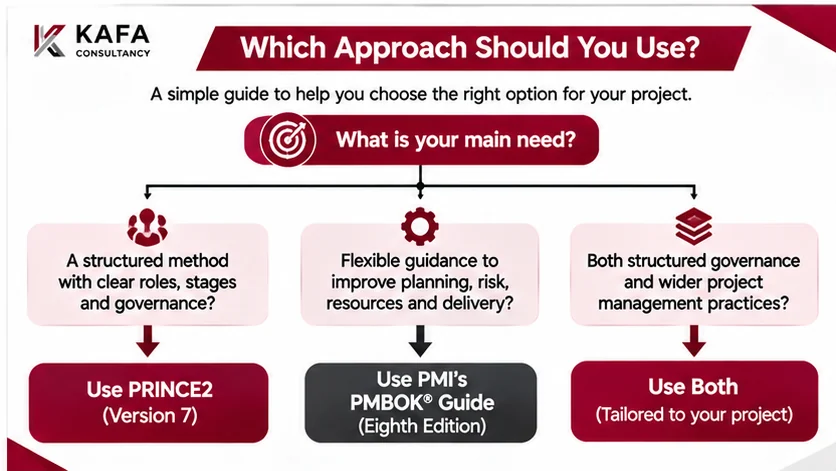
If the company wants a consistent project management method across several teams, a tailored PRINCE2 approach may be useful.
If it mainly wants to improve its current planning, scheduling and control practices, the PMBOK Guide can provide a strong reference.
Many organisations will benefit from elements of both.
For smaller organisations starting from scratch, see our Project Management for Small Business guide.
The following questions can help an organisation decide what it needs.
| Your main requirement | A useful starting point |
|---|---|
| Establish clear project roles and decision authority | PRINCE2 |
| Improve detailed planning and scheduling | PMBOK guidance |
| Create consistent stage reviews and management reporting | PRINCE2 |
| Strengthen risk, finance and resource management practices | PMBOK guidance |
| Manage multiple projects using one common method | Tailored PRINCE2 |
| Combine governance with established planning and control practices | Both |
| Support Agile or Hybrid delivery | Either or both, with suitable tailoring |
Before adopting either approach, consider the amount of administration it will create.
Too many documents or approval stages can slow down a small project.
Too little control can create problems in larger projects with significant costs, risks and dependencies.
The best solution is a practical system that provides enough information and authority for effective decisions.
Treating PMBOK as a fixed methodology. The PMBOK Guide provides standards and guidance. An organisation still needs to decide how its projects will be managed.
Assuming PRINCE2 always requires extensive paperwork. PRINCE2 is designed to be tailored. The level of documentation should reflect the project’s needs.
Calling PRINCE2 Waterfall. PRINCE2 can be used with different delivery approaches.
Applying every process in the same way. Project size, risk and complexity should influence how management practices are applied.
Focusing on certificates instead of delivery. Training can improve knowledge, but successful project management also requires experience, judgement and consistent application.
Ignoring the people involved. A process works only when responsibilities are understood and the team has the information needed to follow it.
Another source of confusion is the difference between PRINCE2, PMBOK and PMP.
These terms refer to different things.
PRINCE2 is a project management method. PeopleCert also offers PRINCE2 certifications.
PMBOK Guide is PMI’s project management guide.
PMP, or Project Management Professional, is a professional certification awarded by PMI to people who meet its eligibility and examination requirements.
Reading or applying the PMBOK Guide does not make someone PMP-certified.
Similarly, using PRINCE2 practices on a project does not mean someone holds a PRINCE2 certification.
When choosing an approach for a business, the more important question is whether the project management system meets the organisation’s needs.
Neither is automatically better. PRINCE2 provides a defined project management method. PMBOK offers broader project management knowledge and guidance. The choice depends on the organisation’s needs.
PRINCE2 explains how to organise and manage a project through a structured method. The PMBOK Guide provides principles, performance domains and practices that can be tailored to different projects.
Yes. A business can use PRINCE2 for governance and management processes while applying PMI guidance for scheduling, risk management, resource planning and project controls.
Yes. PRINCE2 can support Agile and Hybrid delivery when it is tailored to the project. It is not limited to Waterfall.
The PMBOK Guide is a body-of-knowledge guide and part of PMI’s project management standards. It is not a single prescribed methodology.
Both can be useful. PRINCE2 can provide governance and stage control. PMI guidance can help with scheduling, procurement, cost management and risk assessment.
It depends on the business. A small team may benefit from selected practices from both rather than a detailed management structure.
PRINCE2 and PMI’s PMBOK Guide are both valuable project management resources.
PRINCE2 provides a structured method with clear responsibilities, management processes and governance arrangements.
The PMBOK Guide provides wider guidance on the principles and practices needed to manage projects effectively.
The two can work together.
For businesses, the aim should be to establish a project management system that suits the work being delivered.
Start with clear objectives, defined roles, realistic plans and effective controls. Then introduce the practices that help your team manage projects more reliably.
At KAFA Consultancy, we help businesses establish practical project management systems and improve project delivery.
Our services include project planning and scheduling, workflow development, project reporting, risk management and digital project management systems.
Whether your organisation needs a simple project framework or more structured controls, we can help design processes that suit your team and business requirements.
Explore KAFA Consultancy’s Project Management & Automation Services.
Explore 10 project management workflows you can automate, from task assignment and deadline reminders to approvals, reporting and handover, with practical examples.
Read insightBring a delayed project back under control with a practical recovery plan. Learn how to find the causes, review the critical path and choose…
Read insightLearn how to manage project scope changes with a practical change control process, impact assessment, approval workflow and change request example.
Read insight